

Real Deal Guide to Research Peptides
Introduction
Peptides are small protein fragments that send signals in the body.
These signals can affect healing, metabolism, fat loss, skin health, and recovery.
They’re popular because they’re targeted. They tell specific systems what to do instead of affecting everything.
Most peptides are experimental and sold for research use only.
This guide explains what they do, why people use them, risks, and common research dosing.
This is educational information only, not medical advice.
Legal Reality
Most peptides exist in a legal gray area.
• Legal to buy for research purposes
• Not approved as supplements or general medications
• Some peptides are FDA-approved only for specific medical conditions and require prescriptions
• Off-label use should involve medical supervision
• Many peptides are banned by WADA and can cause failed drug tests
• Quality varies due to lack of regulation—verify sourcing and testing
Research Standards Come First
At Real Deal Wellness, everything starts with verification. Before any peptide research discussion happens on this site, we prioritize independent lab validation, repeatable testing standards, and transparent sourcing.
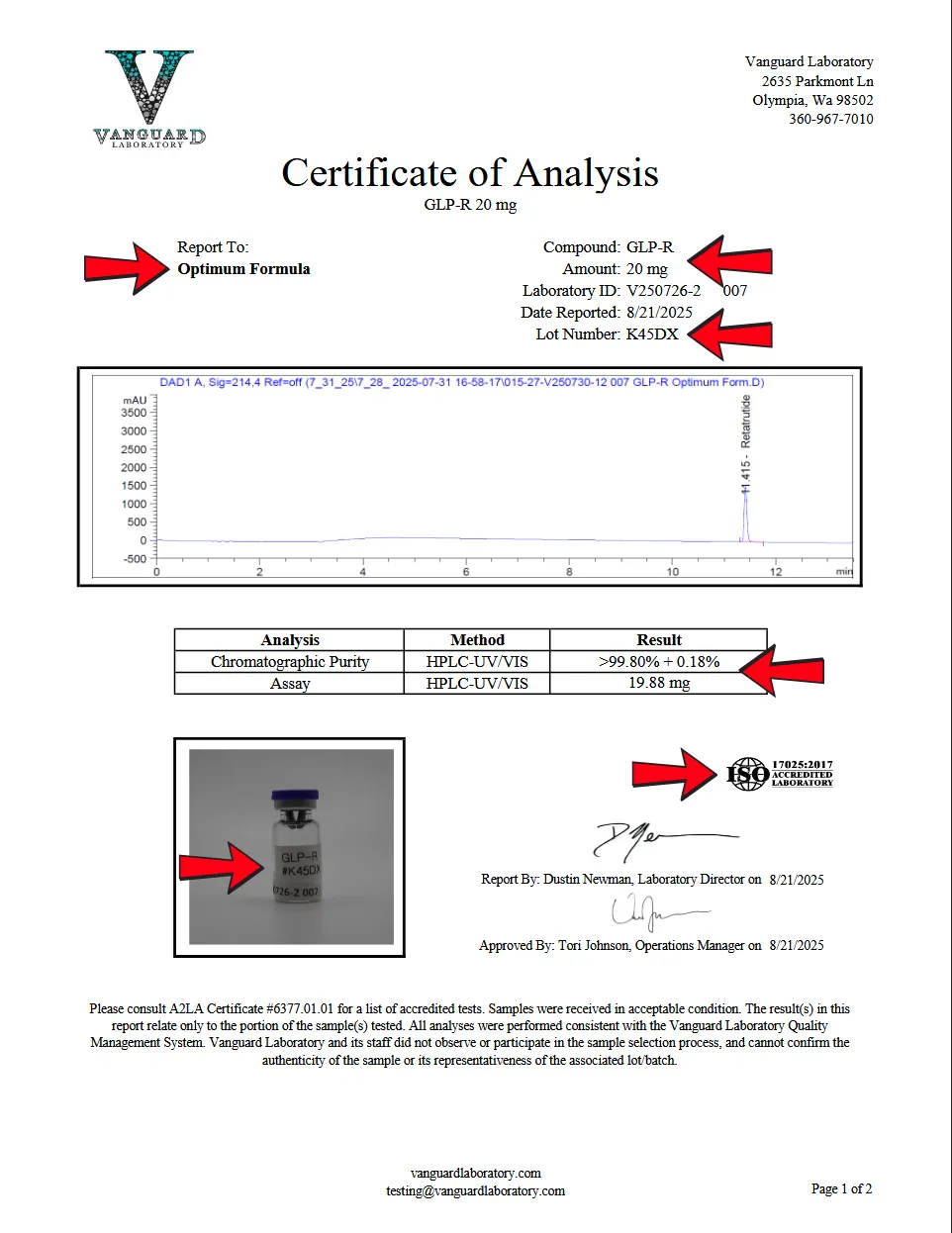
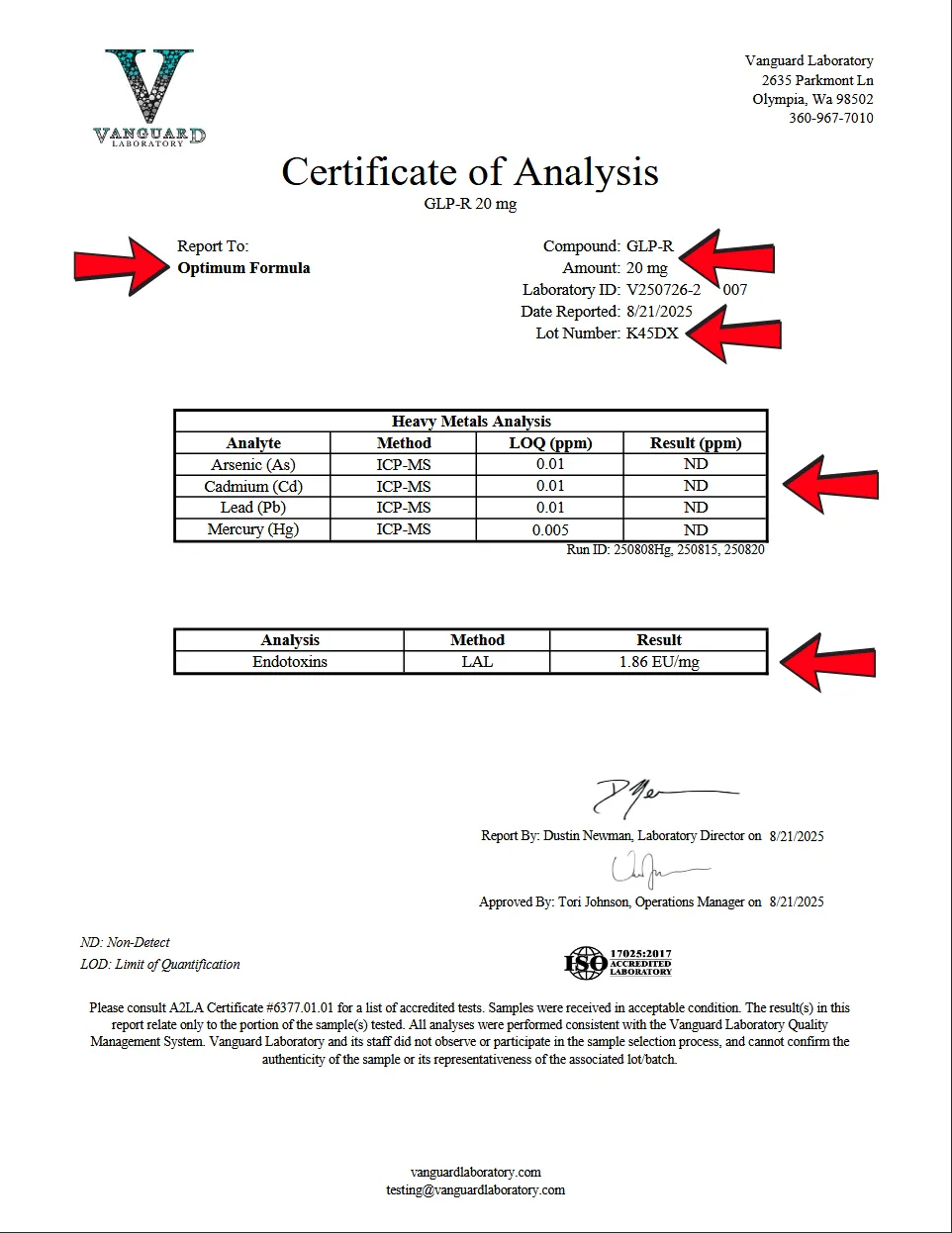
All Certificates of Analysis referenced throughout this guide originate from Vanguard Lab, an ISO-certified laboratory based in Olympia,WA. Every batch is evaluated for purity, quantity accuracy, and endotoxin levels, with sterility and heavy metals tested quarterly across all products.
Because these standards matter, we only align with peptide suppliers that operate at the same level of scrutiny. That’s why we recommend Optimum Formula as our preferred peptide research source.
👉 Access Optimum Formula here: Account Creation Required to View Catalog
https://optimumformula.co/
💡 Use code REALDEAL at checkout for a stackable discount, applied on top of any active site-wide offers.
This ensures the research discussed below is supported by consistent testing, documented verification, and a sourcing standard we trust.
Educational & Research Disclaimer
The information provided in this section is intended for educational and informational purposes only.
No specific medical, dosing, or usage recommendations are made. The content presented reflects general information aggregated from publicly available and trusted sources across the internet and is provided solely to support educational discussion and research literacy.
Readers should always consult a licensed physician or qualified medical professional before making any decisions related to health, wellness, or medical care.
All compounds, products, and substances referenced are for research use only. They are not licensed, approved, or authorized for human or animal use by any regulatory authority unless explicitly stated otherwise.
Nothing in this material should be interpreted as medical advice, treatment guidance, or endorsement of use.
Reconstitution Links:
Real Deal Peptide Dosage Calculator Use this Convenient Dosage Calculator as a visual tool to walk you through the reconstitution math outlined above.
How To Mix Peptides (Step by Step Visual Guide) In this Youtube video watch and learn how to properly reconstitute peptides
Reconstitution & Handling
Most peptides arrive as a dry powder and must be mixed before use.
Supplies Needed
• Peptide vial
• Bacteriostatic water
• Alcohol wipes
• Sterile syringe
• Clean surface
Reconstitution Steps (Air Pressure)
1. Clean the tops of both vials with alcohol
2. Pull air into the syringe equal to the water you will draw
3. Inject that air into the BAC water vial
4. Turn the vial upside down and draw the water
5. Inject the water slowly into the peptide vial
6. Aim the water down the side of the vial
7. Gently swirl until dissolved Never shake
Why Injecting Air Matters
• Air equalizes pressure in the vial
• Proper pressure makes drawing water smooth
• Skipping air causes resistance and inaccurate draws
Concentration
Concentration = peptide amount ÷ water added.
Example: 5 mg + 1 mL = 5 mg/mL.
10 units (0.1 mL) = 500 mcg.
If you can’t calculate this, use a peptide calculator—guessing causes errors.
Storage
• Refrigerate after mixing
• Label the reconstitution date
• Avoid light exposure
• Do not freeze unless instructed
• Use within 4–6 weeks when possible
• Cloudy solution or particles = discard
Sterile Technique
• Use a new needle every time
• Clean vial top before every draw
• Clean injection site before injecting
• Never reuse or share needles
Peptide Reconstitution — Simple Breakdown
Peptide reconstitution is just volume + concentration math.
The Two Conversions
Units ↔ Milliliters
100 units = 1 mL. Units measure volume, not strength. Insulin syringes use units for precision; larger syringes use mL.
Milligrams ↔ Micrograms
1 mg = 1,000 mcg. A 10 mg vial = 10,000 mcg.
Concentration
Concentration = amount of peptide per mL of water. Less water = more concentrated. More water = less concentrated. Concentration determines units drawn, injection comfort, and margin for error.
Why 2 mL Is Preferred
More water reduces injection irritation, increases dosing tolerance, and lowers error risk. Best practice for small vials is 2 mL BAC water.
Example: Retatrutide (10 mg)
1 mL BAC → 10 mg/mL → 2 mg = 20 units.
2 mL BAC → 5 mg/mL → 2 mg = 40 units.
Example: Tesamorelin (5 mg)
1 mL BAC → 5 mg/mL → 1 mg = 20 units.
2 mL BAC → 2.5 mg/mL → 1 mg = 40 units.
Why “Units” Alone Mean Nothing
Units without knowing vial strength and water volume are meaningless.
The Formula
Total peptide ÷ water added = concentration → draw units that equal target dose.
Final Notes
More water = safer and smoother. Less water = higher precision required. Always calculate before injecting.
How to Use the Current Calculator for Blends:
Example: 5mg BPC-157 + 5mg TB-500 blend
1. Add up the total peptide amount: 5mg + 5mg = 10mg total
2. Use the "Custom Amount" option: Enter 10 and select mg
3. Add your water volume: e.g., 2mL
4. Calculate your total desired dose:
If you want 250mcg BPC + 250mcg TB per injection
Total dose = 500mcg (0.5mg)
5. The calculator will show you: How much to draw for that combined dose
The math behind it:
• 10mg total ÷ 2mL = 5mg/mL concentration
• Each mL contains 2.5mg BPC + 2.5mg TB
• To get 250mcg of each (500mcg total): draw 0.1mL
Common BPC/TB Blend Dosing:
• Light: 250mcg each (500mcg total)
• Standard: 500mcg each (1mg total)
• Higher: 750mcg-1mg each (1.5-2mg total)
Example: Glow Blend Vial Let's say your vial contains:
• 5mg GHK-Cu
• 5mg BPC-157
• 5mg TB-500
• Total: 15mg
Using the Calculator:
1. Select "Custom Amount": Enter 15 and select mg
2. Water volume: Add 2mL (or 3mL for easier dosing)
3. Concentration: 15mg ÷ 2mL = 7.5mg/mL total peptides
4. Calculate your dose:
• If you want 200mcg of each peptide per injection
• Total dose = 600mcg (0.6mg)
• Enter 600 and select mcg
5. Result: Shows you exactly how much to draw
The Math:
• With 2mL water: Each mL contains 2.5mg of each peptide
• Drawing 0.08mL gives you ~200mcg of each peptide
Common Glow Blend Dosing:
• Conservative: 150-200mcg each (450-600mcg total)
• Standard: 250mcg each (750mcg total)
• Higher: 300-500mcg each (900-1500mcg total)
Example: KLOW Blend Vial Let's say your vial contains:
• 5mg GHK-Cu
• 5mg BPC-157
• 5mg TB-500
• 5mg KPV
• Total: 20mg
Using the Calculator:
1. Select "Custom Amount": Enter 20 and select mg
2. Water volume: Add 2mL (gives 10mg/mL) or 4mL for easier dosing (5mg/mL)
3. Calculate your dose:
• If you want 250mcg of each peptide per injection
• Total dose = 1,000mcg (1mg)
• Enter 1000 and select mcg (or 1 and select mg)
Example with 2mL water:
• 20mg ÷ 2mL = 10mg/mL total
• Each mL contains 2.5mg of each peptide
• Drawing 0.1mL = 250mcg of each peptide
Common KLOW Blend Dosing:
• Light: 200mcg each (800mcg total)
• Standard: 250mcg each (1mg total)
• Higher: 300-400mcg each (1.2-1.6mg total)
Certificates of Analysis (COAs)
Purpose & Role (Research Context):
• Provide analytical data for a specific batch or lot
• Verify compound identity and reported purity
• Improve transparency and traceability in research settings
• Support quality review and documentation practices
• Offer insight into laboratory testing methods used
What a COA Represents:
• A snapshot of laboratory analysis for one specific batch
• Reported results based on defined analytical methods
• Documentation of purity or assay at the time of testing
What a COA Does NOT Represent:
• Approval or licensing for use
• Confirmation of safety or efficacy
• Authorization for human or animal use
• Medical, therapeutic, or clinical endorsement
Common Information Found on a COA:
• Compound name and identifier
• Batch or lot number
• Date of analysis
• Purity or assay percentage
• Analytical method used (HPLC, LC-MS, etc.)
• Testing laboratory name and authorization
How to Interpret a COA:
• Confirm the lot number matches the referenced material
• Review actual purity values, not just “Pass” results
• Check the testing method used and its relevance
• Note the analysis date for accuracy and relevance
• Understand that not all COAs test for every contaminant
Limitations of COAs:
• High purity does not guarantee biological effect
• COAs do not imply sterility unless explicitly stated
• Results apply only to the tested batch
• Testing standards may vary by laboratory
Best Practices When Reviewing COAs:
• Prefer third-party, independent laboratories
• Avoid cropped, partial, or unsigned COAs
• Look for consistency across multiple batches
• Treat COAs as quality indicators, not guarantees
COA Disclaimer:
• COAs are provided for informational and educational purposes only
• They do not constitute medical advice or product approval
• All compounds referenced are for research use only
• No compound is approved for human or animal use unless explicitly stated by a regulatory authority
👉 Access Optimum Formula here: Account Creation Required to View Catalog
https://optimumformula.co/
💡 Use code REALDEAL at checkout for a stackable discount, applied on top of any active site-wide offers.
Overview of Key Research Peptides:
Below is a list of various research peptides and peptide blends, along with their mechanisms, potential benefits, side effects, and typical dosing practices in research. The information is distilled for clarity. Remember, “common dosing” refers to ranges reported anecdotally or in studies – these are not medical recommendations, just a description of what some researchers or clinics have used. Always start on the lower end if experimenting under professional guidance, and monitor for any adverse reactions.
Injury Repair & Physical Recovery
BPC-157 / TB-500 Blend
Proposed Benefits (Research Context):
• Soft-tissue and connective tissue support
• Angiogenesis and tissue repair signaling
• Reduced inflammation
• Enhanced cellular migration
• Joint and mobility support
Common Research Use Guidelines:
• Daily exposure: ~0.25–1.0 mg total
• Frequency: Once daily or split doses
• Cycle length: 4–6 weeks
• Off period: 2–4 weeks between cycles
Cycle Notes:
• Shorter cycles → acute tissue stress
• Longer cycles → connective tissue / joint focus
• Some protocols reference higher initial exposure followed by lower maintenance
Total Peptide Needed Per Cycle:
• 4 weeks (low): ~14 mg
• 6 weeks (low): ~21 mg
• 4 weeks (high): ~28 mg
• 6 weeks (high): ~42 mg
BPC-157
Proposed Benefits (Research Context):
• Soft-tissue and connective tissue repair support
• Tendon, ligament, and muscle recovery signaling
• Angiogenesis (new blood vessel formation)
• Reduced inflammation and oxidative stress
• Gut lining and GI tract support
• Joint integrity and mobility support
Common Research Use Guidelines:
• Daily exposure: ~0.25–1.0 mg total
• Frequency: Once daily or split doses
• Cycle length: 4–6 weeks
• Off period: 2–4 weeks between cycles
Cycle Notes:
• Shorter cycles → acute tissue stress
• Longer cycles → connective tissue / joint focus
• Some protocols reference higher initial exposure followed by lower maintenance
Total Peptide Needed Per Cycle:
• 4 weeks (low): ~7 mg
• 6 weeks (low): ~10.5 mg
• 4 weeks (high): ~28 mg
• 6 weeks (high): ~42 mg
KPV
Proposed Benefits (Research Context):
• Anti-inflammatory signaling support
• Gut lining and gastrointestinal integrity support
• Immune modulation and cytokine regulation
• Reduced local and systemic inflammation
• Supportive role in tissue recovery environments
Common Research Use Guidelines:
• Daily exposure: ~0.33–0.67 mg
• Frequency: Once daily
• Cycle length: 4–8 weeks
• Off period: 2–4 weeks between cycles
'
Cycle Notes:
• Lower exposure → gut and inflammation-focused research
• Higher exposure → systemic inflammatory modulation
• Frequently used alongside regenerative peptides rather than alone
Total Peptide Needed Per Cycle:
• 4 weeks (low): ~9.2 mg
• 6 weeks (low): ~13.9 mg
• 4 weeks (high): ~18.8 mg
• 6 weeks (high): ~28.1 mg
Glow Blend (GHK-Cu / BPC-157 / TB-500)
Proposed Benefits (Research Context):
• Collagen synthesis and skin elasticity support
• Angiogenesis and tissue repair signaling
• Cosmetic skin, hair, and tissue rejuvenation support
• Reduced inflammation with enhanced tissue resilience
• Systemic connective tissue and recovery support
Common Research Use Guidelines:
• Daily exposure: ~2.35 mg total combined peptides
• Frequency: Once daily
• Cycle length: 4–6 weeks
• Off period: 2–4 weeks between cycles
Cycle Notes:
• Longer cycles → cosmetic and collagen-focused research
• Shorter cycles → recovery and tissue repair focus
• Repeated use includes copper peptide exposure considerations
Total Peptide Needed Per Cycle:
• Based on a daily exposure of ~2.35 mg total combined peptides
• 4 weeks (28 days): ~65.8 mg total peptide content
• 6 weeks (42 days): ~98.7 mg total peptide content
KLOW Blend (GHK-Cu / BPC-157 / TB-500 / KPV)
Proposed Benefits (Research Context):
• Comprehensive connective tissue and soft-tissue support
• Angiogenesis and accelerated tissue repair signaling
• Collagen synthesis and cosmetic skin support
• Anti-inflammatory and immune modulation support
• Systemic recovery and tissue resilience
Common Research Use Guidelines:
• Daily exposure: ~2.66–5.32 mg total combined peptides
• Frequency: Once daily (higher exposures may be split)
• Cycle length: 4–8 weeks
• Off period: 2–4 weeks between cycles
Cycle Notes:
• Lower exposure → recovery, inflammation, and cosmetic support
• Higher exposure → aggressive tissue repair and regeneration focus
• Extended cycles require consideration of copper peptide exposure
Total Peptide Needed Per Cycle:
• Based on ~2.66–5.32 mg total combined peptides per day
• 4 weeks (low): ~74.5 mg
• 6 weeks (low): ~111.7 mg
• 4 weeks (high): ~149.0 mg
• 6 weeks (high): ~223.4 m
Metabolic Health & Weight Management
BPC-157 / TB-500 Blend
Proposed Benefits (Research Context):
• Soft-tissue and connective tissue support
• Angiogenesis and tissue repair signaling
• Reduced inflammation
• Enhanced cellular migration
• Joint and mobility support
Common Research Use Guidelines:
• Daily exposure: ~0.25–1.0 mg total
• Frequency: Once daily or split doses
• Cycle length: 4–6 weeks
• Off period: 2–4 weeks between cycles
Cycle Notes:
• Shorter cycles → acute tissue stress
• Longer cycles → connective tissue / joint focus
• Some protocols reference higher initial exposure followed by lower maintenance
Total Peptide Needed Per Cycle:
• 4 weeks (low): ~14 mg
• 6 weeks (low): ~21 mg
• 4 weeks (high): ~28 mg
• 6 weeks (high): ~42 mg
BPC-157
Proposed Benefits (Research Context):
• Soft-tissue and connective tissue repair support
• Tendon, ligament, and muscle recovery signaling
• Angiogenesis (new blood vessel formation)
• Reduced inflammation and oxidative stress
• Gut lining and GI tract support
• Joint integrity and mobility support
Common Research Use Guidelines:
• Daily exposure: ~0.25–1.0 mg total
• Frequency: Once daily or split doses
• Cycle length: 4–6 weeks
• Off period: 2–4 weeks between cycles
Cycle Notes:
• Shorter cycles → acute tissue stress
• Longer cycles → connective tissue / joint focus
• Some protocols reference higher initial exposure followed by lower maintenance
Total Peptide Needed Per Cycle:
• 4 weeks (low): ~7 mg
• 6 weeks (low): ~10.5 mg
• 4 weeks (high): ~28 mg
• 6 weeks (high): ~42 mg
KPV
Proposed Benefits (Research Context):
• Anti-inflammatory signaling support
• Gut lining and gastrointestinal integrity support
• Immune modulation and cytokine regulation
• Reduced local and systemic inflammation
• Supportive role in tissue recovery environments
Common Research Use Guidelines:
• Daily exposure: ~0.33–0.67 mg
• Frequency: Once daily
• Cycle length: 4–8 weeks
• Off period: 2–4 weeks between cycles
'
Cycle Notes:
• Lower exposure → gut and inflammation-focused research
• Higher exposure → systemic inflammatory modulation
• Frequently used alongside regenerative peptides rather than alone
Total Peptide Needed Per Cycle:
• 4 weeks (low): ~9.2 mg
• 6 weeks (low): ~13.9 mg
• 4 weeks (high): ~18.8 mg
• 6 weeks (high): ~28.1 mg
Glow Blend (GHK-Cu / BPC-157 / TB-500)
Proposed Benefits (Research Context):
• Collagen synthesis and skin elasticity support
• Angiogenesis and tissue repair signaling
• Cosmetic skin, hair, and tissue rejuvenation support
• Reduced inflammation with enhanced tissue resilience
• Systemic connective tissue and recovery support
Common Research Use Guidelines:
• Daily exposure: ~2.35 mg total combined peptides
• Frequency: Once daily
• Cycle length: 4–6 weeks
• Off period: 2–4 weeks between cycles
Cycle Notes:
• Longer cycles → cosmetic and collagen-focused research
• Shorter cycles → recovery and tissue repair focus
• Repeated use includes copper peptide exposure considerations
Total Peptide Needed Per Cycle:
• Based on a daily exposure of ~2.35 mg total combined peptides
• 4 weeks (28 days): ~65.8 mg total peptide content
• 6 weeks (42 days): ~98.7 mg total peptide content
KLOW Blend (GHK-Cu / BPC-157 / TB-500 / KPV)
Proposed Benefits (Research Context):
• Comprehensive connective tissue and soft-tissue support
• Angiogenesis and accelerated tissue repair signaling
• Collagen synthesis and cosmetic skin support
• Anti-inflammatory and immune modulation support
• Systemic recovery and tissue resilience
Common Research Use Guidelines:
• Daily exposure: ~2.66–5.32 mg total combined peptides
• Frequency: Once daily (higher exposures may be split)
• Cycle length: 4–8 weeks
• Off period: 2–4 weeks between cycles
Cycle Notes:
• Lower exposure → recovery, inflammation, and cosmetic support
• Higher exposure → aggressive tissue repair and regeneration focus
• Extended cycles require consideration of copper peptide exposure
Total Peptide Needed Per Cycle:
• Based on ~2.66–5.32 mg total combined peptides per day
• 4 weeks (low): ~74.5 mg
• 6 weeks (low): ~111.7 mg
• 4 weeks (high): ~149.0 mg
• 6 weeks (high): ~223.4 m
Growth Hormone & Body Composition
CJC-1295 (No DAC) / Ipamorelin
Proposed Benefits (Research Context):
• Increased endogenous growth hormone release
• Improved recovery and tissue repair signaling
• Support for lean mass retention
• Enhanced fat metabolism via GH-mediated pathways
• Improved sleep quality and recovery cycles
Common Research Use Guidelines:
• Daily exposure: ~0.25–1.0 mg total combined peptides
• Frequency: Once or twice daily
• Cycle length: 8–12 weeks
• Off period: 2–4 weeks between cycles
Cycle Notes:
• Lower exposure → recovery and sleep support focus
• Higher exposure → body composition and performance support
• Often administered pre-bed or post-workout to align with natural GH pulses
• Mimics physiologic GH release rather than supplying exogenous hormone
Total Peptide Needed Per Cycle:
• 8 weeks (low): ~14 mg
• 12 weeks (low): ~21 mg
• 8 weeks (high): ~56 mg
• 12 weeks (high): ~84 mg
Tesamorelin (GHRH Analog)
Proposed Benefits (Research Context):
• Increased endogenous growth hormone release
• Reduction of visceral adipose tissue signaling
• Improved IGF-1–mediated metabolic support
• Support for fat loss and body composition improvement
• Preservation of physiologic GH pulsatility
Common Research Use Guidelines:
• Daily exposure: 2.0 mg
• Frequency: Once daily
• Cycle length: 8–24 weeks
• Off period: Variable; often protocol- or response-dependent
Cycle Notes:
• FDA-approved dosing is fixed (no escalation required)
• Primarily studied for visceral fat reduction rather than general weight loss
• Maintains natural GH feedback loops (unlike exogenous HGH)
• Often administered at the same time each day for consistency
Total Compound Needed Per Cycle:
• 8 weeks: ~112 mg
• 12 weeks: ~168 mg
• 24 weeks: ~336 mg
IGF-1 LR3 (Acetic Acid Bundle)
Proposed Benefits (Research Context):
• Enhanced muscle cell growth and hyperplasia signaling
• Improved nutrient partitioning and muscle recovery
• Increased satellite cell activation
• Support for lean mass accrual and tissue repair
• Synergistic effects with GH and GH secretagogues
Common Research Use Guidelines:
• Daily exposure: ~0.02–0.05 mg (20–50 mcg)
• Frequency: Once daily
• Cycle length: 4–6 weeks
• Off period: 4–6 weeks between cycles
Cycle Notes:
• Lower exposure → recovery and nutrient uptake focus
• Higher exposure → aggressive hypertrophy signaling
• Often administered post-training or pre-training in research protocols
• Extended use increases desensitization risk due to long half-life
Total Compound Needed Per Cycle:
• 4 weeks (low): ~0.56 mg
• 6 weeks (low): ~0.84 mg
• 4 weeks (high): ~1.40 mg
• 6 weeks (high): ~2.10 mg
Cognitive Function, Mood & Stress Support
Semax
Proposed Benefits (Research Context):
• Cognitive performance and focus support
• Neuroprotection and stress-resilience signaling
• BDNF and neurotrophic pathway support
• Mood, motivation, and mental clarity support
• Mental fatigue and workload tolerance support
Common Research Use Guidelines:
• Daily exposure: ~0.3–0.8 mg
• Frequency: Once daily
• Cycle length: 5–8 weeks
• Off period: 1–2 weeks between cycles
Cycle Notes:
• Lower exposure → focus, cognition, and mental stamina
• Higher exposure → stronger neurostimulatory effects
• Gradual titration improves tolerability
• Often cycled rather than used continuously
Total Compound Needed Per Cycle:
• 5 weeks (low): ~10.5 mg
• 8 weeks (low): ~16.8 mg
• 5 weeks (high): ~28.0 mg
• 8 weeks (high): ~44.8 mg
Selank
Proposed Benefits (Research Context):
• Anxiolytic and stress-reduction support
• Improved emotional regulation and calm focus
• GABAergic and neuroimmune signaling support
• Cognitive clarity without sedation
• Support for mental resilience under stress
Common Research Use Guidelines:
• Daily exposure: ~0.3–0.9 mg
• Frequency: Once daily or split doses
• Cycle length: 5–8 weeks
• Off period: 1–2 weeks between cycles
Cycle Notes:
• Lower exposure → anxiety reduction and calm focus
• Higher exposure → enhanced emotional stability under stress
• Generally non-sedating compared to traditional anxiolytics
• Often cycled rather than used continuously
Total Compound Needed Per Cycle:
• 5 weeks (low): ~10.5 mg
• 8 weeks (low): ~16.8 mg
• 5 weeks (high): ~31.5 mg
• 8 weeks (high): ~50.4 mg
Mitochondrial & Cellular Energy
MOTS-c (Mitochondrial-Derived Peptide)
Proposed Benefits (Research Context):
• Improved mitochondrial efficiency and metabolic signaling
• Enhanced insulin sensitivity and glucose utilization
• Support for fat oxidation and metabolic flexibility
• Exercise endurance and recovery support
• Cellular stress resilience and longevity signaling
Common Research Use Guidelines:
• Average daily equivalent: ~1–3 mg
• Frequency: 2–3× weekly administration
• Cycle length: 4–6 weeks
• Off period: 2–4 weeks between cycles
Cycle Notes:
• Lower exposure → metabolic support and insulin sensitivity focus
• Higher exposure → endurance, fat-loss, and performance signaling
• Typically not administered daily
• Often used in short cycles due to potent mitochondrial effects
Total Compound Needed Per Cycle:
• 4 weeks (low): ~8–12 mg
• 6 weeks (low): ~12–18 mg
• 4 weeks (high): ~24–30 mg
• 6 weeks (high): ~36–45 mg
NAD+ (Nicotinamide Adenine Dinucleotide)
Proposed Benefits (Research Context):
• Improved mitochondrial energy production
• Enhanced cellular repair and redox balance
• Support for fatigue reduction and mental clarity
• Metabolic efficiency and cellular resilience support
• Longevity and recovery signaling pathways
Common Research Use Guidelines:
• Daily exposure: ~50–100 mg
• Frequency: Daily or several times weekly
• Cycle length: Variable (commonly weeks to months)
• Off period: Protocol-dependent
Cycle Notes:
• Lower daily doses commonly used for ongoing energy and recovery support
• Higher cumulative exposure often used in fatigue or metabolic stress protocols
• Rapid administration may increase flushing or cramping
• Route and frequency are adjusted based on tolerability and research goal
Total Compound Needed Per Cycle:
• 4 weeks (50 mg daily): ~1,400 mg
• 4 weeks (100 mg daily): ~2,800 mg
• 8 weeks (50 mg daily): ~2,800 mg
• 8 weeks (100 mg daily): ~5,600 mg
Immune Function
Thymosin Alpha-1 (TA-1)
Proposed Benefits (Research Context):
• Immune system modulation and T-cell activation support
• Enhanced innate and adaptive immune response signaling
• Anti-inflammatory and antiviral pathway support
• Support during periods of immune suppression or high stress
• Adjunct support in recovery and resilience protocols
Common Research Use Guidelines:
• Daily exposure: ~1.0–2.0 mg
• Frequency: 2–3× weekly
• Cycle length: 4–8 weeks
• Off period: 2–4 weeks between cycles
Cycle Notes:
• Lower exposure → immune priming and maintenance support
• Higher exposure → active immune modulation focus
• Often used in short, structured cycles rather than continuously
• May be paired with recovery or anti-inflammatory compounds
Total Compound Needed Per Cycle:
• 4 weeks (low): ~8 mg
• 8 weeks (low): ~16 mg
• 4 weeks (high): ~24 mg
• 8 weeks (high): ~48 mg
Aesthetic, Skin & Hair Health
GHK-Cu (Copper Peptide)
Proposed Benefits (Research Context):
• Collagen synthesis and connective tissue support
• Skin elasticity, firmness, and wound-healing signaling
• Angiogenesis and tissue remodeling support
• Hair follicle and scalp health signaling
• Anti-inflammatory and antioxidant pathway support
Common Research Use Guidelines:
• Daily exposure: ~1.0–2.0 mg
• Frequency: Once daily
• Cycle length: 6–12 weeks
• Off period: 2–4 weeks between cycles
Cycle Notes:
• Lower exposure → cosmetic skin and hair support
• Higher exposure → aggressive collagen and tissue remodeling focus
• Often used in regenerative or cosmetic-focused protocols
• Copper balance should be considered in longer cycles
Total Compound Needed Per Cycle:
• 6 weeks (low): ~42 mg
• 12 weeks (low): ~84 mg
• 6 weeks (high): ~84 mg
• 12 weeks (high): ~168 mg
Melanotan II (MT-II)
Proposed Benefits (Research Context):
• Increased melanogenesis and skin pigmentation support
• Reduced UV exposure requirement for tanning response
• Appetite suppression signaling (secondary effect)
• Libido and sexual arousal signaling (dose-dependent)
• Potential photoprotective effects via melanin increase
Common Research Use Guidelines:
• Daily exposure: ~0.25–1.0 mg
• Frequency: Once daily (often during loading phase)
• Cycle length: 2–4 weeks (loading), then maintenance as needed
• Off period: 2–4 weeks between cycles
Cycle Notes:
• Lower exposure → gradual pigmentation with fewer side effects
• Higher exposure → faster tanning with increased nausea/flushing risk
• Often front-loaded, then reduced to maintenance dosing
• Side effects are most common during initial exposures
Total Compound Needed Per Cycle:
• 2 weeks (low): ~3.5 mg
• 4 weeks (low): ~7.0 mg
• 2 weeks (high): ~14.0 mg
• 4 weeks (high): ~28.0 mg
Glow Blend (GHK-Cu / BPC-157 / TB-500)
Proposed Benefits (Research Context):
• Collagen synthesis and skin elasticity support
• Angiogenesis and tissue repair signaling
• Cosmetic skin, hair, and tissue rejuvenation support
• Reduced inflammation with enhanced tissue resilience
• Systemic connective tissue and recovery support
Common Research Use Guidelines:
• Daily exposure: ~2.35 mg total combined peptides
• Frequency: Once daily
• Cycle length: 4–6 weeks
• Off period: 2–4 weeks between cycles
Cycle Notes:
• Longer cycles → cosmetic and collagen-focused research
• Shorter cycles → recovery and tissue repair focus
• Repeated use includes copper peptide exposure considerations
Total Peptide Needed Per Cycle:
• Based on a daily exposure of ~2.35 mg total combined peptides
• 4 weeks (28 days): ~65.8 mg total peptide content
• 6 weeks (42 days): ~98.7 mg total peptide content
Sexual Health & Well-Being
PT-141 (Bremelanotide)
Proposed Benefits (Research Context):
• Libido and sexual arousal signaling support
• Central melanocortin receptor activation
• Improved sexual desire independent of blood flow
• Support for sexual performance and responsiveness
• Potential mood and motivation effects (secondary)
Common Research Use Guidelines:
• Per-use exposure: ~0.25–1.0 mg
• Frequency: As needed (commonly up to ~8 uses per month)
• Cycle length: Not traditionally cycled
• Off period: Not applicable
Cycle Notes:
• PT-141 is not used in structured cycles
• Typically administered on-demand rather than daily or weekly
• Usage is generally limited to avoid tolerance and side effects
• Often spaced several days apart rather than clustered
Total Compound Needed Per Month:
• Low use (0.25 mg × 4 uses): ~1.0 mg
• Moderate use (0.5 mg × 6–8 uses): ~3.0–4.0 mg
• High use (1.0 mg × 8 uses): ~8.0 mg
Our Trusted Peptide Research Partner
At Real Deal Wellness, we’re extremely selective about the sources we recommend for peptide research. After extensive review and ongoing experience, Optimum Formula has earned our full endorsement as our preferred peptide research supplier.
Optimum Formula consistently delivers:
-Research-grade compounds with rigorous quality standards
-Transparent documentation and batch verification
-Professional handling, packaging, and fulfillment
-A research-first approach aligned with long-term reliability
If you’re conducting peptide-based research and want a source we confidently stand behind, Optimum Formula is the partner we trust.
👉 Access Optimum Formula here: Account Creation Required to View Catalog
https://optimumformula.co/
💡 Exclusive Savings for Real Deal Wellness Readers
Use code REALDEAL at checkout for a stackable discount, applied on top of any existing site-wide offers.
This partnership reflects our commitment to pointing our community toward sources that prioritize quality, consistency, and integrity in peptide research.
Discover More Wellness
Red Light Therapy
Revitalize Your Skin and Health with the Power of Cellular Renewal.
Infrared Sauna
Detoxify and Rejuvenate with the Healing Power of Heat.
Compression Therapy
Enhance Recovery and Reduce Swelling with the Benefits of Compression Therapy.
Halotherapy
Recharge Your Respiratory Health and Rejuvenate Your Skin with Halotherapy
Massage Chairs
Relax and let your knots melt away.


